
What is teacher evaluation documentation
costing school leaders in your district?
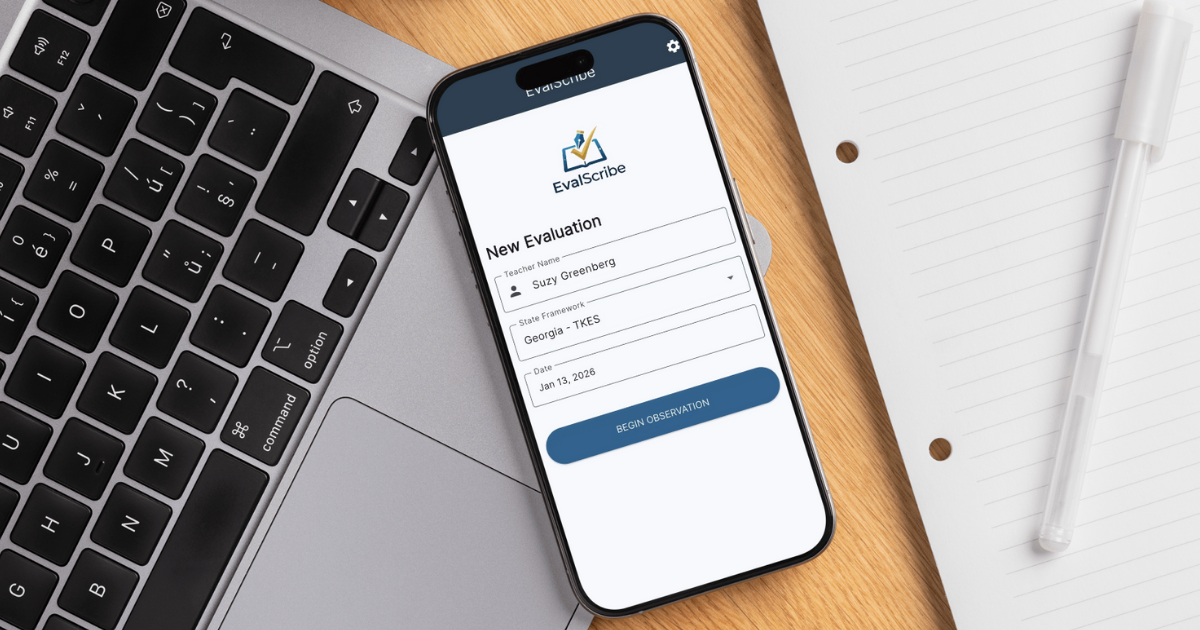
Every evaluator in your district is spending hours a week turning walkthrough notes into write-ups — at wildly different speeds and wildly different quality. EvalScribe helps every one of them turn notes into a clear, professional write-up in minutes, organized by the rubric your district already uses, with no IT project and nothing new for your district to secure.
Nothing new for your district to secure
No integration, no rollout project
Plus D.C. — works with your district's framework
From purchase to every evaluator live
One access code covers your whole purchase · Each evaluator sets up in minutes · No credit card required to explore
District and school leaders on EvalScribe
Game changer. Absolute game changer for school admin.
Tobin Davidson · Assistant Superintendent · 40+ years in education
This is amazing. I would pay lots of money for this. I’m serious — it’s crazy good.
Glenn Brown · Director of Student Services
Also from Dr. Robert Stinson · Kittie Brown · Angie Brandt — read full quotes ↓
One evaluator writing slowly is a Tuesday night. Forty of them is a district problem.
Multiply one evaluator's write-up time across every school in your district, and three things happen at once.
Wildly inconsistent quality
A 20-year veteran principal and a first-year AP are writing evaluations against the same rubric — but not in the same language, at the same depth, or with the same defensibility. That variance is invisible until it matters.
Evaluator time, disappearing
Every hour an evaluator spends translating notes into rubric language is an hour not spent in classrooms, coaching teachers, or leading their building. Across a district, that adds up to real, recoverable capacity.
Thin, hard-to-defend records
When an evaluation is challenged, a vague or rushed write-up is a liability. Evidence-organized documentation that holds up against your district's rubric, produced consistently at every school, is what protects you.
What EvalScribe actually gives your district back.
This isn't money back in your budget — it's evaluator time back in your buildings. Set this to your district's real numbers and see exactly where that time comes from.
Already spending, every year
1,800 evaluations × 45 min each, just writing up evaluations
Here's the math
Your district runs about 1,800 evaluations a year (40 evaluators × 15 teachers × 3 observations). EvalScribe saves roughly 35 minutes on each one, handing back 1,050 hours of evaluator time to your buildings.
You spend
Your administrators get back
not dollars in the budget — capacity back in your buildings
Hours back, per admin
Workdays reclaimed, districtwide
These figures are estimates based on the numbers you enter above — not a guarantee, and not a budget reduction. This calculator reclaims labor capacity, not dollars: your administrators' salaries don't change and no line item shrinks. What changes is what that reclaimed time gets spent on. Actual results will vary by district. EvalScribe savings assume roughly 10 minutes per evaluation with EvalScribe, based on typical user time after the first few evaluations, at the district-wide licensing rate of $80 per evaluator per year. Adjust any figure above to match your district — the math updates as you go.
That capacity doesn't show up as a smaller budget line — it shows up in classrooms, coaching conversations, and evenings your administrators get back. See what that actually looks like ↓
What your administrators get back isn't only time.
In a 2021 survey by the National Association of Secondary School Principals, a third of principals said they were considering leaving the profession — and workload was one of the top concerns they named. Evaluation write-ups are a real, recurring piece of that load: hours that come out of evenings, weekends, and the time an administrator would otherwise spend actually leading their building.
More time in classrooms
Hours reclaimed from write-ups are hours available for walkthroughs, coaching conversations, and actually being present in the building — not behind a desk finishing paperwork.
Feedback while it's still fresh
When write-ups don't pile up, teachers get feedback closer to the actual observation — which is when it's most useful for actually changing practice.
Evenings and weekends back
Evaluation paperwork is one of the most common things administrators tell us they take home. Reclaiming that time is a quality-of-life win your evaluators will feel immediately.
A retention lever, not just a workload fix
Administrator burnout is a real driver of turnover — and turnover is expensive to replace at every level. Reducing one of the heaviest recurring workload items is a small, concrete step toward keeping good leaders in your buildings.
Source: National Association of Secondary School Principals, 2021 survey. Teacher replacement cost figures ($11,860–$24,930 depending on district size) from the Learning Policy Institute's 2024 update — cited here because well-supported, well-fed-back teachers are one documented factor in retention, not as a claim that EvalScribe has been independently studied for this effect.
Watch EvalScribe turn notes into a finished evaluation.
The math above is easy to believe once you've watched it happen. This is a real observation, from capture and organizing evidence to suggested ratings and final export, in a few minutes.
No IT project. No training curriculum. No rollout plan.
This is the entire process, start to finish. There isn't a step we left off the page.
Purchase district licensing
Tell us how many evaluator seats you need. We'll get you a quote — just email us.
Get your access code
One code, covering every seat you purchased.
Evaluators download & enter it
Each evaluator downloads EvalScribe from the App Store on their own iPhone, iPad, or Mac and enters the code.
A year of EvalScribe Pro, live
That's it — every evaluator can start using EvalScribe right away.
Your evaluators already know how to observe a classroom. They don't need to learn a new system to write it up — EvalScribe's interface is the same intuitive capture-and-draft flow whether someone's using it for the first time or the fiftieth.
It's not just what EvalScribe does. It's everything you don't have to do.
Every ed-tech purchase comes with a tail of hidden costs that never show up on the invoice: the SSO integration, the rostering feeds, the password resets, the vendor security review, the data-governance headache. Your technology director has scar tissue from every one of them. EvalScribe was built to not have that tail.
| What usually happens | A typical ed-tech rollout | With EvalScribe |
|---|---|---|
| Identity & SSO | ✕Weeks of IT coordination to integrate with your identity provider. | ✓Not needed. One access code covers your whole purchase — no SSO to configure. |
| Rostering & data feeds | ✕A sync job pulling student and staff data from your SIS. | ✓None. EvalScribe never connects to your student information system. |
| Usernames & passwords | ✕New accounts to provision, and a queue of reset requests to follow. | ✓None to manage. The access code is the only credential, entered once per device. |
| Training & PD day | ✕A session to schedule, staff to pull from their day, and a curriculum to build. | ✓Not required, as above — the same simple flow, first day or fiftieth. |
| Vendor security review | ✕Often lengthy, especially for tools that store sensitive personnel data. | ✓Simpler by design — there's no new centralized data pool to review or secure. |
| IT ticket queue | ✕A predictable spike during any new software rollout. | ✓Effectively zero. Each evaluator sets up independently, on their own device. |
| Implementation timeline | ✕Weeks to months is typical for a district-wide tool. | ✓Same day as purchase, as shown above — every evaluator can be live before the week is out. |
One consistent standard across your whole district.
EvalScribe supports evaluators in all 50 states and Washington D.C., including districts that use widely adopted national models. Whether your district runs one framework across every school or your evaluators come from different backgrounds and training, every write-up EvalScribe drafts is organized by the framework your evaluator chooses. A first-year AP and your most veteran principal get the same clear structure to work from, so evaluations across your district read like they came from the same well-trained team.
"Can't our evaluators just use ChatGPT?"
It's the first question most district leaders ask, and it's a fair one. A general-purpose AI tool can produce a paragraph that sounds like an evaluation. Across dozens of evaluators and every school in your district, "sounds like one" and "actually is one" are very different things — and the gap between them is exactly where district-level risk lives.
| At district scale | ChatGPT, Claude, or similar | EvalScribe |
|---|---|---|
| Framework awareness | ✕No built-in knowledge of any specific rubric — every evaluator has to describe or paste in the framework themselves, every time. | ✓Works with evaluators in all 50 states and D.C. Each evaluator chooses their framework and writes it up in one place. |
| Consistency across evaluators | ✕Output quality depends entirely on how well each individual evaluator prompts it — with 40 evaluators, that's 40 different results. | ✓The same clear structure every time, regardless of who's using it or how experienced they are. |
| Rubric accuracy | ✕Regularly invents indicator names, domain labels, and rubric language that don't exist in the actual framework. | ✓Organizes your evidence by the framework components your district uses, so evaluators can check it against the rubric. |
| Note capture | ✕Requires retyping every observation as a prompt before it can help at all. | ✓Accepts typed notes, dictation, or photos of handwritten notes via Smart Scan OCR. |
| Data privacy at scale | ✕Free and consumer tiers may retain and use what's typed in to train public models — a new data-governance question for every school using it. | ✓Transient processing, no data storage, never used for training — no new vendor risk to add to your governance policy. |
| Defensibility | ✕Generic output that's hard to trace back to specific evidence — a real liability if an evaluation is ever challenged. | ✓Every comment is tied to evidence pulled from the evaluator's own notes and the rubric component it supports. |
| Accountability & procurement | ✕Ad hoc use of a consumer account — no vendor agreement, no per-seat pricing, no one accountable if something goes wrong. | ✓One vendor relationship, one predictable per-evaluator price, purpose-built for exactly this workflow. |
General AI is a genuinely useful tool for a lot of things. Producing consistent, defensible evaluations across every school in a district — at the speed and volume your evaluators actually need — isn't one of them.
We don't store evaluation data. That's not a gap — it's the design.
Every note an evaluator captures is processed transiently on Microsoft Azure and never retained on EvalScribe's servers. Finished evaluation records stay locally on the evaluator's own device, under a local-first architecture. That means EvalScribe doesn't create a new centralized pool of sensitive personnel evaluation data for your district to secure, govern, or worry about in a breach. There's no district dashboard aggregating evaluation content — by design, not by omission.
Transient processing
Notes are processed and discarded — not stockpiled on our servers.
Local-first records
Finished evaluations live on the evaluator's own device, not a shared cloud database.
No training-data reuse
Your evaluators' notes are never used to train public AI models.
Nothing new to govern
No new data-sharing agreement, no new system for your data governance policy to cover.
For the full detail your IT and legal teams will want, see our Privacy Policy. Districts needing a Data Processing Agreement or FERPA attestation can request one at [email protected].
What district & school leaders are saying.
Real feedback from administrators across roles — from the superintendent's office to the principal's office.
Game changer. Absolute game changer for school admin.
Tobin Davidson
Assistant Superintendent · 40+ years in education
After seeing a detailed demonstration of EvalScribe, I came away very impressed with both the concept and the execution. The platform provides administrators with a practical way to quickly capture classroom observations and generate high-quality, customized feedback that remains aligned to their evaluation framework and local expectations. What stood out most was the balance between efficiency and quality. EvalScribe has the potential to reduce administrative workload while helping school leaders provide more timely and meaningful feedback to teachers — a tool with considerable promise for schools and districts.
Glenn Brown
Director of Student Services
EvalScribe is a tool that every public school principal should use. This resource literally makes multiple people out of administrators, allowing them to focus their energies on precise observation analysis and quality feedback while leaving EvalScribe to handle the mechanics. This tool will remove virtually all of the drudgery from the classroom evaluation process and would represent an excellent use of school funds.
Dr. Robert Stinson
Principal
This is amazing. I would pay lots of money for this. I’m serious — it’s crazy good. I look forward to using it on a regular basis next year.
Kittie Brown
Assistant Principal
Evaluators spend an inordinate amount of time recording and documenting evaluations. This app is easy to use, affordable, and incredibly efficient. It cuts the time spent recording and documenting evaluations down significantly and frees us up to handle other aspects of the job. Plus, the conference suggestions save on prep time when a conference is warranted.
Angie Brandt
Academic Coach
Built by educators, for educators.
EvalScribe was co-founded by a practicing classroom teacher and his wife — a husband-and-wife team with thirty years of combined classroom and business experience.

Anthony Neely, Ph.D.
Co-founder · Product
A tenured K–12 classroom teacher and Professional Learning Lead. District Teacher of the Year, with nearly 20 years in education and three published books.

Andrea Neely, Ph.D.
Co-founder · Business
Associate Professor of Management. Research and teaching in organizational management.
Your principals don't need your permission to start.
Here's the honest version: any principal in your district can already try EvalScribe free today, and at $100 a year, plenty will simply put it on a school card without waiting on a district process. That's real, and it's fast — and if it shows up first in a handful of buildings, that's a fine way for EvalScribe to prove itself to you before you commit district-wide.
But that's also exactly the problem this page opened with: some evaluators using it, some not, different buildings developing different habits, with no way to know which schools are documenting consistently and which aren't. A district-wide license isn't primarily about the discount. It's the only way to give every evaluator, in every building, the same tool for producing clear, defensible documentation, instead of a patchwork of whoever happened to sign up on their own.
The better rate is real, too — a flat $80 per evaluator instead of $100. That's just the second reason to centralize, not the first.
Priced for every evaluator, not per school.
One access code covers your entire purchase. Every evaluator gets a full year of EvalScribe Pro the moment they enter it.
The whole pricing model
Number of evaluators × $80 = Your total annual cost
No implementation fee. No per-school add-on. No hidden tiers to negotiate.
District-wide
For districts deploying across every evaluator.
Flat rate, any seat count
- One access code for your entire purchase
- Works with every framework your schools use
- No per-seat IT setup or roster upload
- Direct support contact for your rollout
School-wide
For a single school with multiple evaluators.
3+ evaluators
- Everything in Individual
- One access code per school
- Good fit for piloting one building first
Individual
For one evaluator to try it themselves, today.
3 free evaluations to start — no purchase order needed
- Any of your evaluators can try this now
- No commitment from the district required
- See it firsthand before you approve a purchase
All pricing shown is introductory and may change. District licensing is a flat $80 per evaluator per year at any seat count — email us your evaluator count and we'll send a formal quote for your purchase order.
Questions district leaders actually ask.
How do we actually get this rolled out to 40 evaluators?
You email us with your evaluator count, we get you a quote, and once purchased you receive one access code covering every seat. Each evaluator downloads EvalScribe from the App Store on their own device and enters that code for a full year of Pro access. There's no roster upload, no admin console, and no separate training day — most evaluators are productive the same day.
Can our evaluators try it before we commit district-wide?
Yes — right now, without waiting on us. Any evaluator in your district can download EvalScribe today and try three evaluations free, individually, before your district purchases anything. That's often the fastest way for a superintendent's office to get real feedback before approving a district-wide license.
Does one access code work across multiple schools?
Yes. When you purchase district licensing, you get a single access code sized to the number of seats you bought, and it works for any evaluator across any school in your district — you don't need a separate code per building.
Can we choose when our subscription period starts?
Yes. When your district makes payment, just tell us what day you'd like your one-year subscription period to begin — the start of the school year, the start of your evaluation cycle, whatever fits your calendar.
What if our schools use different evaluation frameworks?
EvalScribe supports evaluators in all 50 states and Washington D.C., so schools that use different frameworks can each evaluate against their own. Each evaluator simply selects the framework their school uses inside the app. Questions about a specific framework? Email [email protected].
Does EvalScribe give us any district-level reporting or a dashboard?
No — and that's intentional. EvalScribe doesn't centralize evaluation content anywhere; notes are processed transiently and finished evaluations stay on each evaluator's own device. That means there's no district dashboard aggregating evaluation data, but it also means EvalScribe never becomes a new pool of sensitive personnel data your district has to secure or govern.
Does this require anything from our IT department?
No integration, no SSO setup, and no data pipeline to build. EvalScribe runs as a standalone app on each evaluator's own iPhone, iPad, or Mac. If your IT or legal team wants the full privacy and security detail, point them to our Privacy Policy.
How is pricing structured for a large district?
District-wide licensing is a flat $80 per evaluator per year — the same rate whether you're licensing ten seats or two hundred. Multiply your evaluator count by $80 and that's your total. Email [email protected] with your seat count and we'll send a formal quote for your purchase order.
What happens at the end of our one-year subscription?
If your district wants to continue, we'll send an invoice, and once it's paid you'll receive a new access code for the following year. If your district chooses not to renew, district-wide access ends — but any individual evaluator who wants to keep using EvalScribe can continue on their own, at the individual rate, directly through the App Store.
Does EvalScribe replace our evaluators' professional judgment?
No. EvalScribe drafts evidence-organized evaluations and suggested ratings from an evaluator's own observation notes. Every evaluator reviews, edits, and finalizes their own documents before anything is submitted. EvalScribe removes the typing, not the judgment.
What happens to our access code if an evaluator leaves the district?
Reach out to [email protected] and we'll help you manage seat reassignment as your staffing changes throughout the year.
More questions? Reach out via our contact page — we read every message personally.
The math works out
before you even sign anything.
No IT project, no training curriculum, and a per-seat cost that's typically a fraction of the evaluator time it reclaims. Watch it in action, or have any of your evaluators try it free today — no purchase required either way.
One access code per district · No credit card required to explore · Works with every state framework · Or talk to us about licensing